European Women's Management Development International Network
EWMD Male Allies: "Women Who Lead on Male Allyship"
Watch the full recording here: https://youtu.be/mU9DhOHtk60?si=ouRFAtFmo5zltkVS
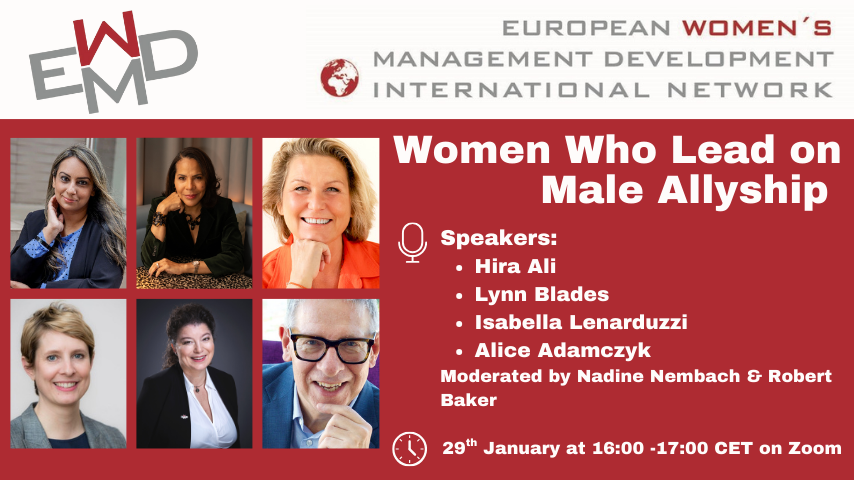
As part of its ongoing Male Allyship series, EWMD convened an expert panel to explore how women leaders are shaping and advancing male allyship in organisations. The session brought together Hira Ali (author and allyship trainer), Lynn Blades (Founder of Legacy Leadership), Isabella Lenarduzzi (Founder of JUMP), and Alice Adamczyk (Men As Allies Co-Lead at Pfizer’s Global Women’s Resource Group). The discussion was hosted by Nadine Nembach and moderated by Robert Baker.
The panel began by reframing allyship as action rather than intention. Allies are not saviours but partners who use their access to power responsibly. Allyship means working side by side with women as sponsors, advocates and mentors, and addressing systemic barriers embedded in organisational processes. The panel agreed that terminology is less important than behaviour: what matters is whether men are willing to use their influence to change outcomes.
A key challenge identified was resistance and fear among men. Many fear saying the wrong thing, facing backlash, or losing status. Others feel excluded from gender equality conversations. The panel argued that engagement improves when allyship is framed as good leadership rather than moral obligation. Men benefit personally and professionally from inclusive leadership through better relationships, broader perspectives and stronger collaboration.
Several real-life examples illustrated the impact of allyship. One case described training delivered to police officers in Pakistan, where resistance initially dominated the room. By the end, a participant recognised how his everyday language reinforced gendered abuse and committed to change his behaviour. Another example showed how menopause awareness prevented a highly qualified candidate from being unfairly excluded during a board recruitment process.
Organisational responsibility featured strongly throughout the discussion. Panelists stressed that bias cannot be trained out of individuals alone; it must be designed out of systems. Key strategies include:
The panel began by reframing allyship as action rather than intention. Allies are not saviours but partners who use their access to power responsibly. Allyship means working side by side with women as sponsors, advocates and mentors, and addressing systemic barriers embedded in organisational processes. The panel agreed that terminology is less important than behaviour: what matters is whether men are willing to use their influence to change outcomes.
A key challenge identified was resistance and fear among men. Many fear saying the wrong thing, facing backlash, or losing status. Others feel excluded from gender equality conversations. The panel argued that engagement improves when allyship is framed as good leadership rather than moral obligation. Men benefit personally and professionally from inclusive leadership through better relationships, broader perspectives and stronger collaboration.
Several real-life examples illustrated the impact of allyship. One case described training delivered to police officers in Pakistan, where resistance initially dominated the room. By the end, a participant recognised how his everyday language reinforced gendered abuse and committed to change his behaviour. Another example showed how menopause awareness prevented a highly qualified candidate from being unfairly excluded during a board recruitment process.
Organisational responsibility featured strongly throughout the discussion. Panelists stressed that bias cannot be trained out of individuals alone; it must be designed out of systems. Key strategies include:
- Formalising sponsorship so it becomes a structured process rather than informal goodwill.
- Redesigning promotion and performance systems to ensure fairness.
- Making inclusion visible through data, targets and accountability mechanisms.
- Linking leadership incentives and bonuses to progress on gender balance and inclusion.
The panel highlighted that different groups of men must be engaged differently. Senior leaders shape culture and incentives; managers determine daily experiences; colleagues influence norms and behaviour. Change must therefore operate at all levels simultaneously.
Another important theme was menopause and hormonal health as career barriers. The panel underlined the organisational cost of losing experienced women at mid-career stages and called for greater education and empathy among male leaders. Addressing these issues openly strengthens talent retention and fairness.
On the question of what will accelerate gender equality fastest, the panel agreed there is no single solution. Male allyship must operate alongside women’s development, regulatory frameworks, targets and inclusive HR processes. Progress stalls when only women are asked to change, while men and systems remain untouched.
The session concluded with a strong call to action:
Gender equality cannot be achieved by women alone. Male allyship must become part of leadership capability, supported by systems, metrics and everyday practice. When men and women collaborate to redesign organisations together, inclusion becomes not only a value, but a strategic advantage.
Another important theme was menopause and hormonal health as career barriers. The panel underlined the organisational cost of losing experienced women at mid-career stages and called for greater education and empathy among male leaders. Addressing these issues openly strengthens talent retention and fairness.
On the question of what will accelerate gender equality fastest, the panel agreed there is no single solution. Male allyship must operate alongside women’s development, regulatory frameworks, targets and inclusive HR processes. Progress stalls when only women are asked to change, while men and systems remain untouched.
The session concluded with a strong call to action:
Gender equality cannot be achieved by women alone. Male allyship must become part of leadership capability, supported by systems, metrics and everyday practice. When men and women collaborate to redesign organisations together, inclusion becomes not only a value, but a strategic advantage.
